5 Tools for Building and Deploying AI Agents in Production
Our take
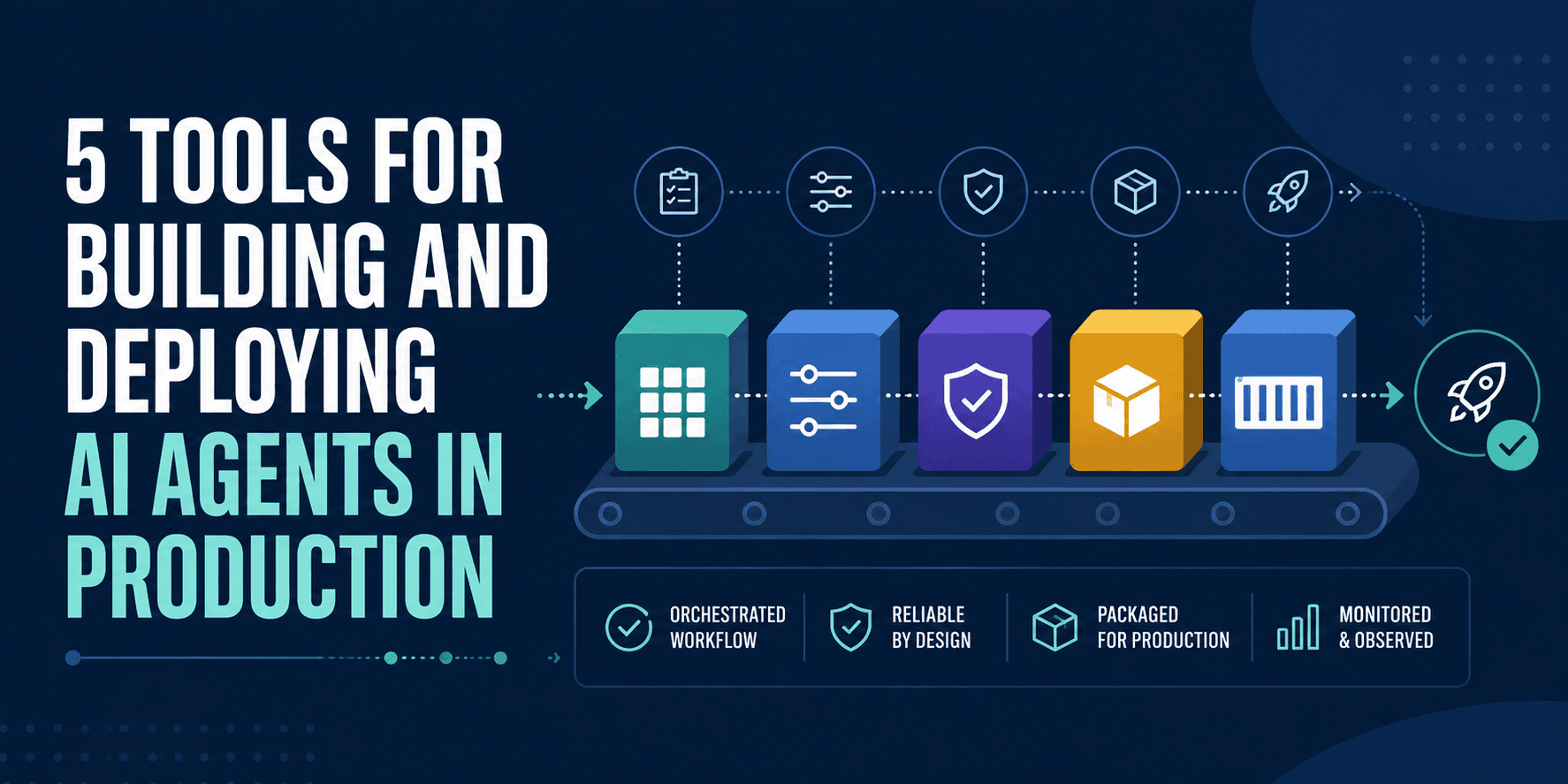
The rapid proliferation of AI agents is undeniably reshaping how we interact with data and automate workflows, and the article "5 Tools for Building and Deploying AI Agents in Production" provides a valuable snapshot of the evolving ecosystem. It’s encouraging to see a focus on the complete stack, recognizing that building an agent is only the first step; deploying and scaling it reliably requires a cohesive architecture. As we’ve previously explored in [AI isn’t close to curing cancer. This startup says it knows what it will take.], the core challenge isn’t always the algorithms themselves, but rather the quality and accessibility of the underlying data – a consideration that becomes even more critical when agents are autonomously interacting with and generating new data. This layered approach, highlighted in the article, acknowledges the complexity inherent in operationalizing AI, moving beyond proof-of-concept demonstrations to real-world utility.
The selection of tools across different layers – from agent logic construction to runtime infrastructure – demonstrates a maturation of the field. Previously, many developers were cobbling together solutions from disparate components, resulting in brittle and difficult-to-manage systems. The availability of purpose-built tools for each stage simplifies the process and lowers the barrier to entry, allowing more organizations to leverage the power of AI agents. It also highlights the growing importance of orchestration and management tools, often overlooked in early AI enthusiasm. Considering the recent advancements in multi-agent collaboration, as detailed in [Multi Agent Collaboration Gets Persistent Compute in Bedrock AgentCore], the ability to manage and scale these increasingly complex systems becomes paramount. Furthermore, the needs of individuals entering the field, as evidenced by discussions like [how can I learn Machine Learning for Astronomical use? [D]], underscores the demand for accessible and streamlined toolchains that facilitate learning and experimentation.
However, the focus on tools shouldn't overshadow the fundamental importance of agent design and prompt engineering. While the right infrastructure is crucial for deployment, the agent’s logic and its ability to effectively interact with its environment remain the primary drivers of success. The article implicitly acknowledges this by emphasizing the initial layer dedicated to agent logic, but continued investment in research and best practices around agent design will be essential. The ability to build agents that are not only functional but also reliable, safe, and aligned with human values is a challenge that demands ongoing attention. We’re seeing a shift from simply building *an* agent to building *the right* agent for a specific purpose, requiring a deeper understanding of the problem domain and a more nuanced approach to agent design.
Ultimately, the tools highlighted in the article represent a significant step towards democratizing access to AI agent technology. The ability to build and deploy agents at scale, without requiring a team of specialized engineers, unlocks a wide range of possibilities for businesses and individuals alike. As these tools continue to evolve and integrate, we can expect to see even more innovative applications emerge, transforming everything from customer service and data analysis to scientific research and creative expression. The question now isn't *if* AI agents will become ubiquitous, but rather *how* we can ensure their development and deployment are guided by principles of responsibility, transparency, and human well-being.
Read on the original site
Open the publisher's page for the full experience