Mastering the AI Project Cycle: From Concept to Production
Our take
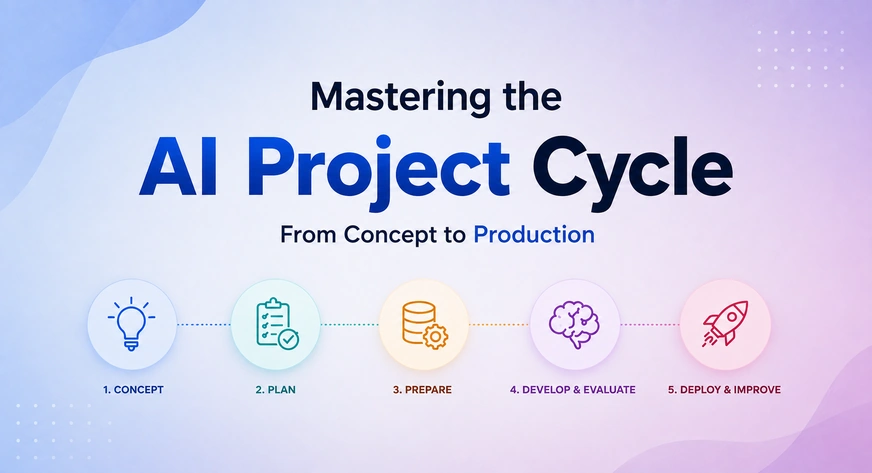
The recent Analytics Vidhya piece, "Mastering the AI Project Cycle: From Concept to Production," offers a crucial corrective to a pervasive misconception within the AI landscape. Too often, the narrative focuses on the dazzling potential of models and the allure of vast datasets, overlooking the rigorous, iterative process required to translate those elements into tangible value. The article rightly emphasizes that building a successful AI system isn’t a matter of simply selecting a model and throwing data at it; it's a structured journey encompassing problem definition, development, deployment, and crucially, ongoing monitoring and refinement. This perspective aligns with our own observations—we’ve seen firsthand how teams shortcutting this cycle frequently encounter frustrating results and ultimately fail to realize the promised benefits of AI. It’s a reminder that a solid foundation, built on careful planning and continuous evaluation, is paramount. Understanding the AI Project Cycle also complements the discussion around Agentic AI, particularly as highlighted in Is Agentic AI Just Automation?, which underscores the importance of avoiding simplistic, flowchart-like implementations and instead building systems capable of genuine adaptability.
The structured approach outlined in the Analytics Vidhya article speaks directly to the challenges faced by data scientists and project managers alike. Moving beyond the initial excitement of model selection requires a disciplined focus on defining clear objectives, ensuring data quality, and establishing robust evaluation metrics. Furthermore, the emphasis on continuous improvement is particularly relevant in today's rapidly evolving AI landscape. Models degrade over time, data distributions shift, and new techniques emerge—all of which necessitate ongoing monitoring and retraining. This continuous feedback loop, often overlooked in initial project planning, is essential for maintaining the accuracy and relevance of AI systems. It’s a point further reinforced by understanding the intricacies of ensemble methods, as explored in Why Random Forest Needs to Be This Random, where even seemingly established techniques require a deep understanding of underlying principles to achieve optimal performance. The article’s focus on the entire lifecycle is a welcome shift from the often-narrow focus on model performance alone.
This shift in perspective – from a model-centric to a cycle-centric view – represents a maturing of the AI field. We’re moving beyond the hype and towards a more pragmatic understanding of what it takes to build truly valuable AI solutions. Organizations are increasingly recognizing that AI is not a plug-and-play technology, but rather a complex undertaking requiring significant investment in people, processes, and infrastructure. The need for robust governance frameworks, clear accountability, and ongoing monitoring is becoming increasingly apparent. The article’s emphasis on deployment and continuous improvement highlights the operational realities of AI – the challenges of integrating models into existing workflows, ensuring data privacy and security, and scaling solutions to meet evolving business needs. Even the seemingly technical details of retrieval augmented generation (RAG) are deeply impacted by this cycle, as shown by How Does a RAG Reranker Really Work?, where the effectiveness of the system relies heavily on the ongoing refinement of the retrieval and ranking components.
Looking ahead, the concept of the AI Project Cycle will likely become increasingly embedded in AI education and training programs. As AI adoption continues to accelerate, organizations will need to develop standardized methodologies and best practices for managing AI projects throughout their entire lifecycle. The ability to define clear objectives, measure impact, and adapt to changing conditions will be critical for success. The question remains: how can we best equip data scientists and business leaders with the skills and tools they need to navigate this complex landscape and ensure that AI investments deliver lasting value? The future of AI isn’t about building the smartest models, but about effectively integrating them into the broader organizational ecosystem, guided by a disciplined and iterative approach.
In fact, AI projects are not built by simply choosing a model and feeding it data. Furthermore, a successful AI system goes through multiple stages, starting with identifying the right problem and ending with deployment, monitoring, and continuous improvement. This structured journey is known as the AI Project Cycle. It helps teams move from an […]
The post Mastering the AI Project Cycle: From Concept to Production appeared first on Analytics Vidhya.
Read on the original site
Open the publisher's page for the full experience