Is Agentic AI Just Automation?
Our take
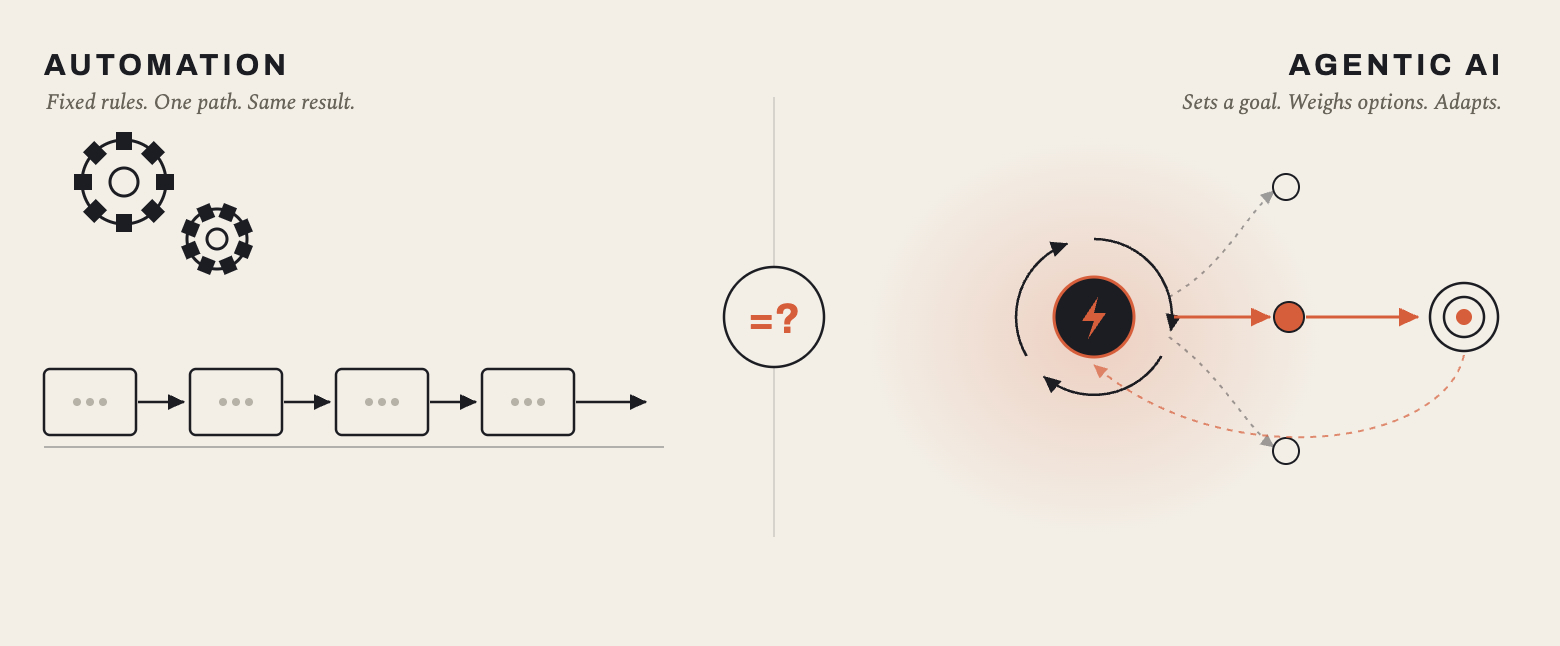
The recent discourse around "agentic AI" has generated considerable excitement, promising a new era of autonomous systems capable of tackling complex tasks. However, a thoughtful piece on Towards Data Science, Is Agentic AI Just Automation?, raises a crucial point: many current implementations are, in essence, sophisticated flowcharts masquerading as intelligent agents. The article rightly challenges the hype, arguing that simply stringing together a series of predefined actions, even with the inclusion of LLMs for decision-making, doesn't equate to genuine agency. This resonates with our own observations, particularly when considering the limitations of current retrieval-augmented generation (RAG) systems, as explored in How Does a RAG Reranker Really Work?, where the illusion of understanding can easily overshadow the underlying mechanics. The core issue isn't the technology itself – LLMs and automated workflows are powerful tools – but rather the misapplication of the term “agent” to systems that lack true adaptability and learning capabilities.
The distinction is vital because it shapes expectations and guides development. True agentic AI, as we envision it, moves beyond pre-programmed responses and embraces a continuous cycle of observation, learning, and adaptation within a dynamic environment. Current "agentic" systems often struggle when faced with unexpected scenarios or require deviations from the established flowchart. They lack the ability to reason about their actions, understand the consequences, and proactively adjust their strategies. This isn't to say that current approaches are without merit; automating repetitive tasks with LLMs can significantly boost productivity, as demonstrated by techniques for leveraging tools like Claude Code, as detailed in How to Effectively Solve 100+ Tasks with Claude Code. However, framing these as fully autonomous agents risks overpromising and ultimately disappointing users. The article’s call to move beyond flowcharts towards systems capable of true planning and self-correction is a necessary corrective to the current trend.
The future of agentic AI hinges on addressing this fundamental limitation. It requires a shift in focus from simply chaining together actions to building systems that can model the world, reason about goals, and learn from experience. This will likely involve incorporating techniques from reinforcement learning, planning algorithms, and knowledge representation, allowing agents to proactively explore their environment and adapt their strategies based on observed outcomes. We believe the next generation of truly agentic systems will prioritize internal state management – a clear understanding of what the agent knows, what it needs to know, and how it can acquire that knowledge – over simply executing a sequence of instructions. This internal model will be crucial for handling uncertainty, navigating unexpected situations, and achieving long-term goals.
Ultimately, the conversation around agentic AI needs to be grounded in reality. While the potential is undeniably transformative, it’s crucial to avoid the trap of equating automation with true agency. The challenge lies in moving beyond cleverly disguised flowcharts to build systems that genuinely learn, adapt, and reason—systems that can proactively solve problems and empower users in ways that current tools simply cannot. The question now is: how can we accelerate the development of these genuinely adaptive AI systems, and what new evaluation metrics will be needed to accurately assess their capabilities beyond simple task completion?
Why most agents are just flowcharts in disguise, and what to build instead.
The post Is Agentic AI Just Automation? appeared first on Towards Data Science.
Read on the original site
Open the publisher's page for the full experience