PagedAttention vs. RadixAttention: Optimizing LLM KV Cache Management
Our take
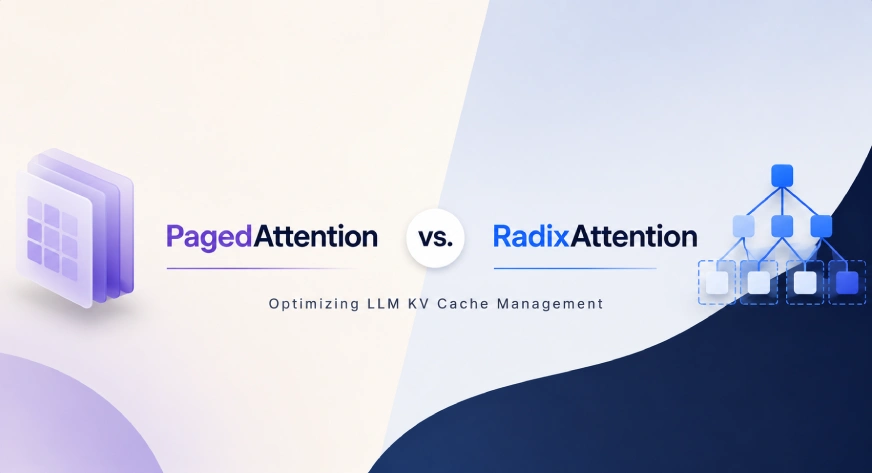
The relentless scaling of Large Language Models (LLMs) has unlocked remarkable capabilities, but also exposed fundamental bottlenecks. While advancements in quantization, pruning, and attention mechanisms have grabbed headlines, the Analytics Vidhya piece highlighting The LLM Judge That Kept Agreeing With Itself underscores a critical truth: production performance often hinges on less glamorous, but equally vital, infrastructure optimizations. The focus on KV cache management, as detailed in the article, is a prime example. As context windows expand—a key driver of LLM utility—the sheer volume of data stored in the KV cache rapidly consumes GPU memory, directly impacting concurrency, throughput, and latency. This isn’t a theoretical concern; it’s a practical limitation directly affecting the responsiveness and scalability of LLM-powered applications. The emergence of PagedAttention and RadixAttention represents a significant step towards addressing this challenge, showcasing the ingenuity required to push the boundaries of what’s possible with existing hardware.
PagedAttention’s improvement in memory allocation and RadixAttention’s efficient prefix reuse are not isolated breakthroughs. They are indicative of a broader trend toward architectural innovation focused on optimizing resource utilization. We’ve seen similar efforts in other areas of AI infrastructure, reflecting a growing awareness that raw compute power alone isn’t sufficient. Companies are increasingly realizing that squeezing maximum performance out of existing hardware is often more cost-effective than simply throwing more GPUs at the problem. Consider, for instance, the discussion around integrating AI agents into existing workflows, as exemplified by NanoClaw comes to Slack, letting you create persistent AI agent teams and colleagues from a single message. Efficient resource management is paramount to making such integrations practical and scalable for enterprise adoption. The ability to reuse prefixes within the KV cache, as RadixAttention enables, directly translates to lower memory footprint and improved efficiency, ultimately leading to faster inference times and reduced operational costs.
The broader significance of these developments extends beyond immediate performance gains. They signal a shift in focus within the LLM ecosystem – from solely pursuing ever-larger models to prioritizing architectural efficiency and intelligent resource management. This is particularly important as the industry grapples with the environmental impact of training and deploying these massive models. Optimizing KV cache management, alongside other efficiency-focused techniques, contributes to a more sustainable AI landscape. Furthermore, these advancements pave the way for more accessible LLM deployments. By reducing the hardware requirements, PagedAttention and RadixAttention democratize access to sophisticated AI capabilities, allowing smaller organizations and individual developers to leverage the power of LLMs without prohibitive infrastructure investments. Thinking about career paths within the space, understanding these underlying architectural nuances is increasingly valuable, as highlighted in How to Build a Career in AI: 3 Distinct Pathways—the ability to optimize model performance at the infrastructure level is becoming a sought-after skill.
Looking ahead, the evolution of KV cache management will likely continue to be a critical area of innovation. We can anticipate further refinements to existing techniques, as well as the emergence of entirely new approaches. The interplay between hardware and software will become even more crucial, with specialized hardware accelerators potentially playing a key role in optimizing KV cache operations. The question now is: will these advancements be enough to keep pace with the ever-increasing demands of expanding context windows and more complex LLM architectures, or will entirely new paradigms be required to unlock the next level of performance and scalability?
Modern LLMs rely on quantization, pruning, distillation, and faster attention kernels, but production performance often depends most on KV cache management. As context windows grow, the cache consumes significant GPU memory, limiting concurrency, throughput, and latency. Two breakthroughs transformed this challenge: PagedAttention improves memory allocation, while RadixAttention enables efficient prefix reuse. Together, these techniques make […]
The post PagedAttention vs. RadixAttention: Optimizing LLM KV Cache Management appeared first on Analytics Vidhya.
Read on the original site
Open the publisher's page for the full experience