This Python Library Can Run Pandas Workloads Up to 20x Faster
Our take
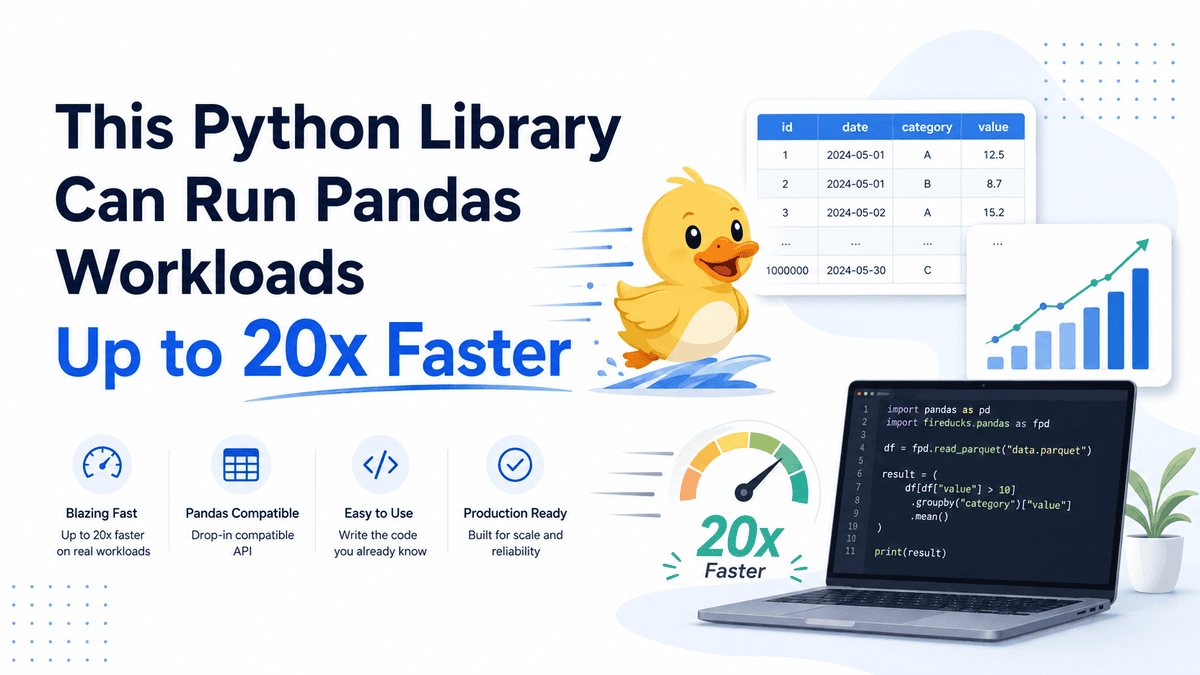
The recent emergence of FireDucks, a Python library promising up to 20x speedups for pandas workloads, signals a compelling evolution in how we approach data manipulation. Pandas remains a cornerstone of the Python data science ecosystem, but its performance can become a significant bottleneck, particularly when dealing with large datasets. While solutions like PySpark offer distributed processing capabilities, they introduce complexity and aren’t always the ideal choice for smaller, single-machine analyses. We’ve previously explored the broader landscape of performance optimization in AI workflows, highlighting common pitfalls 7 Common Python Mistakes to Avoid in AI Workflows – and FireDucks addresses a key one directly. Understanding the nuances of performance optimization, especially in GPU-accelerated environments, is crucial, as discussed in our piece on Triton What kinds of ML bottlenecks are a good fit for Triton?, and FireDucks offers a more accessible entry point than many GPU-focused solutions.
FireDucks’ approach, leveraging lazy execution, compiler optimization, and multithreaded processing, is particularly noteworthy. Lazy execution, in essence, postpones computations until absolutely necessary, avoiding unnecessary overhead and allowing for more efficient resource utilization. Compiler optimization then refines this lazy execution plan, transforming it into the most performant sequence of operations. Finally, multithreading enables parallel processing, distributing the workload across multiple CPU cores for substantial gains in speed. The reported 20x performance improvement in benchmarks is impressive, though it's important to remember that real-world results will vary depending on the specific workload and data characteristics. The accessibility of this optimization is also a key differentiator; users don’t necessarily need to be experts in compiler design or low-level optimization techniques to benefit from FireDucks' capabilities. This stands in contrast to some other approaches which require significant code refactoring or architectural changes.
The significance of FireDucks extends beyond simply accelerating individual pandas operations. It represents a broader trend towards smarter, more efficient data processing tools. Traditional spreadsheets, even advanced ones, are fundamentally limited in their ability to handle the scale and complexity of modern data. While window functions in PySpark A Practical Introduction to PySpark Window Functions provide powerful analytical capabilities, the overhead of distributed processing can be substantial for smaller datasets. FireDucks offers a compelling alternative, allowing data scientists to retain the familiar and versatile pandas API while achieving significantly improved performance on a single machine. This aligns with a future-focused vision where data manipulation isn't a bottleneck, but rather a fluid and responsive process. It allows for faster iteration, quicker insights, and ultimately, more productive data exploration.
Looking ahead, the success of FireDucks hinges on its continued development and adoption within the data science community. Will other libraries and frameworks incorporate similar optimization techniques? Will we see a broader shift towards lazy execution and compiler-driven performance improvements across the entire Python data ecosystem? The potential for further acceleration, particularly when combined with emerging hardware advancements like specialized AI accelerators, is substantial. It will be interesting to observe how FireDucks evolves and whether it inspires a new wave of innovation in the realm of data processing performance. The key question remains: can libraries like FireDucks bridge the gap between the ease of use of pandas and the performance demands of increasingly complex data analysis tasks?
Read on the original site
Open the publisher's page for the full experience