What is Meta Prompting and How does it work?
Our take
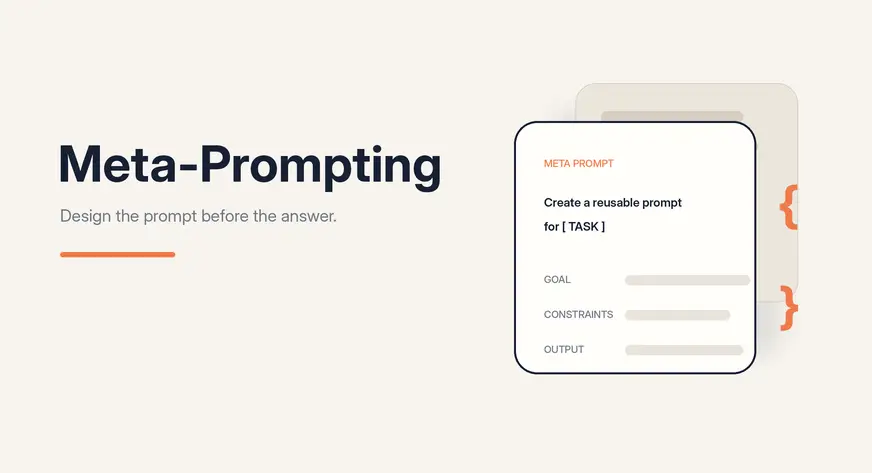
The rise of large language models (LLMs) has fundamentally altered how we interact with data and technology, but the initial excitement around their raw capabilities is giving way to a more nuanced understanding of prompt engineering. As teams increasingly rely on LLMs for repeatable tasks requiring consistent formatting, tone, or structure, the limitations of manually crafting and refining prompts become apparent. The concept of meta-prompting, as explored in You can build your AI's memory just by talking. Here's the catch. #AI #aiagents #AImemory, addresses this challenge directly by leveraging the LLM itself to design the prompts that will govern its future actions. This shift represents a significant step toward automating and optimizing the prompt engineering process, moving beyond ad-hoc experimentation to a more structured and scalable approach. The implications are particularly profound for organizations seeking to integrate LLMs into their workflows and standardize their AI-powered processes.
Meta-prompting isn’t simply about generating better prompts; it's about building a layer of self-awareness and recursive capability into the LLM. It asks the model to analyze the desired outcome, the constraints, and the nuances of a task, and then to synthesize a prompt, template, checklist, or even a complete workflow that will consistently deliver the expected results. Consider the challenges outlined in Article: Comprehension at AI Speed: Building a Context Store for Evolutionary Architecture – the initial rapid progress in development often hides underlying architectural complexity. Meta-prompting can contribute to mitigating this, by proactively designing prompts that incorporate and manage context, potentially reducing the need for extensive post-hoc architectural adjustments. This reflects a broader trend towards AI systems that are not just reactive but also proactive in shaping their own operational parameters. Exploring techniques to reduce LLM latency and inference costs, as detailed in 12 Ways to Reduce LLM Latency and Inference Costs in Production, further underscores the economic imperative to optimize prompt design— effectively, meta-prompting contributes to a more efficient and cost-effective utilization of LLMs.
The significance of meta-prompting extends beyond mere efficiency gains. It democratizes access to the power of LLMs, allowing users with limited prompt engineering expertise to achieve consistent and predictable results. This is particularly important as organizations seek to scale their AI initiatives and empower a wider range of employees to leverage these powerful tools. Instead of relying on a small team of specialists to craft and maintain prompts, teams can leverage the LLM’s own capabilities to generate and refine prompts tailored to their specific needs. This shift fosters a more agile and collaborative approach to AI development, enabling faster experimentation and iteration. The ability to create reusable prompt templates also reduces the risk of drift and ensures that AI-powered processes remain aligned with organizational goals over time.
Ultimately, meta-prompting represents a move towards more autonomous and self-optimizing AI systems. As LLMs become increasingly integrated into our workflows, the ability to automate and refine the prompt engineering process will be critical for maximizing their value. The question moving forward is not just *how* to build better prompts, but *how to empower AI to build its own prompts*, continuously adapting and evolving to meet the ever-changing demands of the data landscape. This evolution suggests a future where the line between prompt engineer and AI collaborator blurs, unlocking new levels of productivity and innovation across a wide range of industries.
Prompts shape every interaction with a large language model. Clear instructions produce focused, useful responses, while vague ones often lead to inconsistent results. This becomes harder when teams need the same task completed repeatedly in a fixed format, tone, or structure. Meta-prompting asks the model to design a reusable prompt, template, checklist, or workflow before […]
The post What is Meta Prompting and How does it work? appeared first on Analytics Vidhya.
Read on the original site
Open the publisher's page for the full experience