Agentic AI vs AI Automation: What’s the Real Difference?
Our take
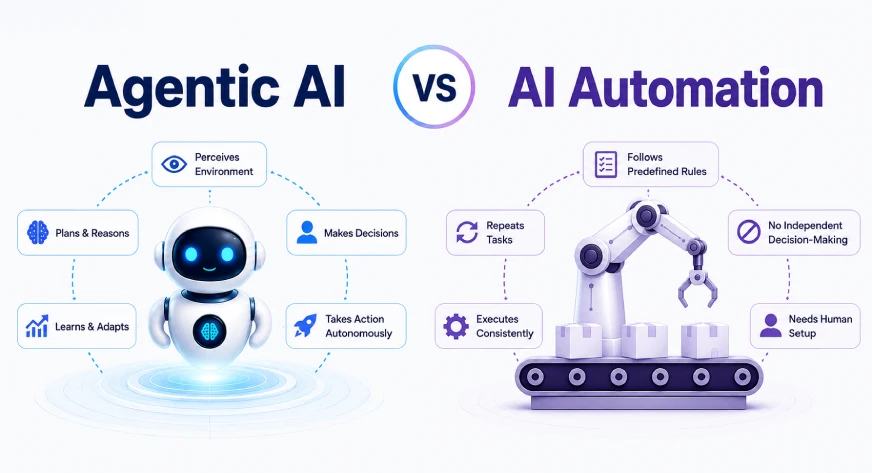
The recent surge in interest surrounding “agentic AI” has created a fascinating, and sometimes misleading, distinction from more traditional AI automation. The scene described in the Analytics Vidhya article—enthusiastic demos followed by frustrating production failures—is a common one. Teams, eager to harness the power of tools like LangChain, are quickly assembling what they believe to be sophisticated AI agents, only to discover their creations lack the robustness required for real-world applications. This isn’t a reflection of the technology’s potential, but rather a misunderstanding of the fundamental differences between automating tasks and building truly autonomous agents. The rise of AI-powered tools is reshaping how we interact with technology, as evidenced by the discussions around [AI and the rise of the universal entertainment app] and the evolving role of evaluations, as highlighted by [Evals are the new PRD, Expedia’s AI chief tells VB Transform 2026]. Understanding these distinctions is crucial for navigating this rapidly evolving landscape.
The core difference lies in adaptability. AI automation excels at performing predefined tasks consistently and efficiently. Think of a script that automatically extracts data from invoices or a chatbot that answers frequently asked questions. These systems follow a rigid set of instructions. Agentic AI, on the other hand, aims to create systems capable of planning, reasoning, and adapting to unforeseen circumstances. A true AI agent should be able to receive a broad goal, break it down into smaller steps, select appropriate tools, and adjust its approach based on the outcomes of each step – all without explicit pre-programming for every possible scenario. This aspiration for autonomy is naturally more complex and prone to failure, particularly when the real world throws curveballs that weren't accounted for in the initial design. The emergence of platforms like Buzz, [Jack Dorsey is taking on Slack with Buzz, a group chat platform for teams and their AI agents] further underscores the ambition to integrate AI agents seamlessly into collaborative workflows, but also highlights the challenges of creating reliable and predictable AI behavior.
The production failures described in the article stem from this gap between aspiration and reality. While a demo might showcase an agent successfully navigating a curated set of inputs, the moment that agent encounters an unexpected situation – a missing data field, an ambiguous request, or a simple typo – the lack of robust planning and error handling can quickly derail the entire workflow. Building reliable agentic AI requires more than just stringing together a few API calls. It demands a focus on robust planning algorithms, sophisticated error detection and recovery mechanisms, and, crucially, a rigorous testing and evaluation process that goes far beyond a single demo. The emphasis on “evals” as a new form of product requirements document, as discussed by Expedia’s AI chief, points to the growing recognition of the need for continuous monitoring and refinement of AI agent behavior.
Ultimately, the current landscape represents an early stage in the evolution of agentic AI. While the hype surrounding fully autonomous agents might be premature, the underlying principles – the ability to reason, plan, and adapt – are essential for unlocking the full potential of AI. The challenge lies not in abandoning the pursuit of agentic AI, but in approaching it with a clear understanding of its limitations and a commitment to building systems that are both powerful and reliable. Moving forward, it will be fascinating to observe how developers prioritize robustness and adaptability in their AI agent designs, and whether we see a shift towards more modular, easily maintainable architectures that can gracefully handle the inevitable uncertainties of the real world.
This scene is playing out across engineering teams everywhere. Someone wraps a few LangChain calls inside a loop, adds a couple of tools, and proudly declares, “We’ve built an AI agent.” The demo looks great. Everyone is impressed. Then it goes to production. The first unexpected input arrives. The workflow breaks. Logs fill up. Alerts start firing. […]
The post Agentic AI vs AI Automation: What’s the Real Difference? appeared first on Analytics Vidhya.
Read on the original site
Open the publisher's page for the full experience